
No products in the cart.
The Science Behind Better Air Movement
HOW IT WORKS
MOVE
Large-diameter blades move high volumes of air at low speed.
DISTRIBUTE
Air travels downward and outward across the floor area.
CIRCULATE
The airflow creates continuous circulation and helps redistribute accumulated warm air.
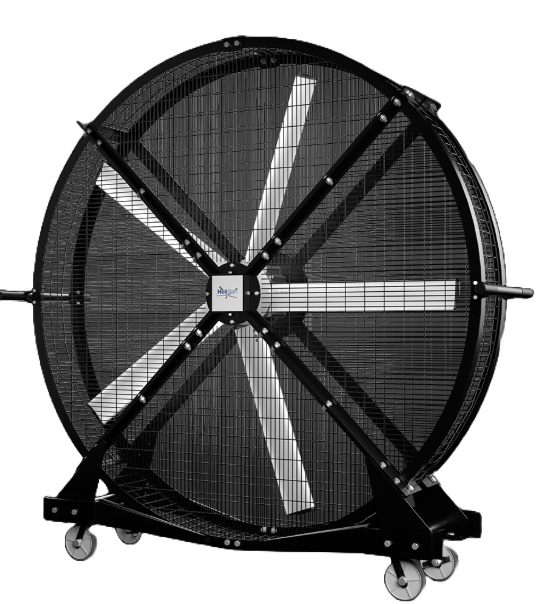
More than cooling — engineered air circulation for large spaces.
Why HVLS Fans?
High Volume, Low Speed
HVLS fans use large-diameter blades to move substantial volumes of air at relatively low rotational speeds, creating broad and consistent airflow across large spaces.
Airflow Distribution
Air moves downward from the fan and then spreads outward across the floor, creating a wide circulation pattern that helps distribute airflow throughout the occupied space.
Destratification
In large buildings, warmer air can accumulate near the ceiling. HVLS airflow helps mix and redistribute this air, reducing temperature differences between upper and occupied zones.
Wide-Area Coverage
Broad airflow across large floor areas.
DESTRATIFICA-TION
Helps mix accumulated warm air with lower-level air.
Improved Comfort
Creates continuous air movement across occupied areas.

Two approaches to HVLS drive technology.
PMSM vs. Geared Motors
| Feature | PMSM / Gearless | Geared |
|---|---|---|
| Drive System | Direct drive | Gear transmission |
| Mechanical Components | Fewer moving parts | Gearbox components |
| Maintenance | Lower mechanical maintenance potential | Periodic gearbox maintenance may be required |
| Noise | Typically quieter | Gear operation can produce mechanical noise |
| Efficiency | High efficiency potential | Depends on motor and gearbox |
| Application | Efficiency-focused installations | Heavy-duty applications |
| Speed Control | VFD / controller depending on model | VFD / controller depending on model |
NATURAL VENTILATION
Wind-Driven vs. Powered Roof Ventilation
Wind-Driven Roof Ventilation
How it works
Uses natural wind movement and pressure differences to help exhaust warm and stale air through roof-level ventilators.
Advantages
- Uses natural airflow
- No fan motor required
- Low operating requirements
- Suitable for naturally ventilated buildings
Best suited for
- Industrial sheds
- Warehouses
- Workshops
- Agricultural buildings
- Naturally ventilated facilities
Powered Roof Ventilation
How it works
Uses electrically powered exhaust equipment to actively remove air from the building.
Advantages
- Controlled extraction
- Less dependent on wind conditions
- Suitable for applications requiring active ventilation
- Can be integrated into planned ventilation systems
Best suited for
- Industrial facilities
- Process areas
- High-heat environments
- Buildings requiring controlled extraction
What does HVLS mean?
HVLS stands for High Volume Low Speed. HVLS fans are designed to move large volumes of air at relatively low rotational speeds.
What is destratification?
Destratification is the mixing of warmer air accumulated near the ceiling with air in the lower occupied zone.
What is a gearless HVLS fan?
A gearless HVLS fan uses a direct-drive motor arrangement without a conventional gearbox.
What is PMSM technology?
PMSM stands for Permanent Magnet Synchronous Motor. It is a motor technology used in various high-efficiency applications, including some HVLS fan systems.
Which is better: PMSM or geared?
Neither is universally better. The appropriate technology depends on the application, operating conditions, duty requirements and project priorities.